
Through the Brazilian artist’s Constructivism and the American’s Minimalism, the rigor of the cross is put to the test
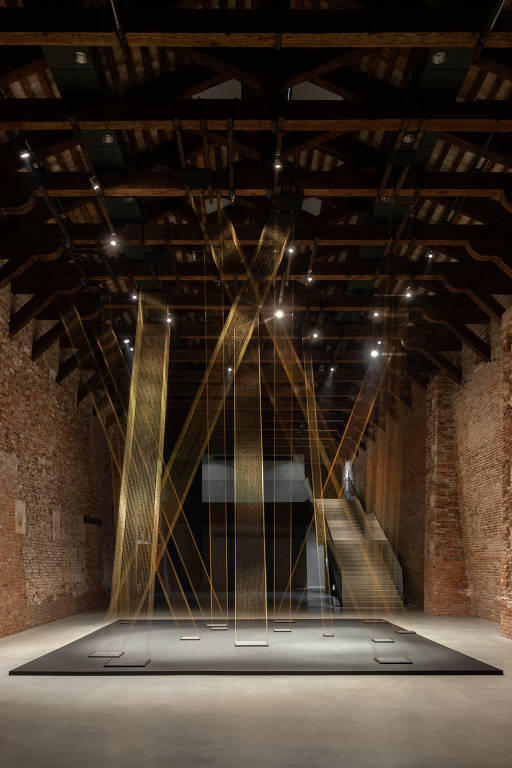
In the darkness of a cathedral, even cobwebs seem golden. The extremely fine threads of the work by Lygia Pape recall rays of light cutting through the darkness — an almost absent presence revealed by the faintest reflection of the spotlights.
One of the classics of the Brazilian artist’s career, the piece now installed at Punta della Dogana, one of the museums owned by French billionaire François Pinault in Venice, Italy, is the iconoclastic reverse of the central idea of the exhibition currently on view.
While the surrounding works address the power of icons — from emblematic faces of religious tradition to the most banal skull as a trace of humanity that endures in bone — Pape reduces the power of a saint to the golden rays that surround it in liturgical imagery.
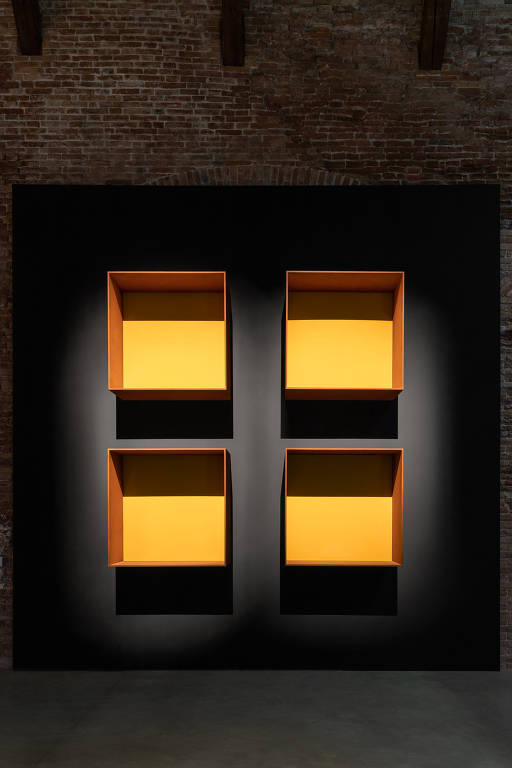
It is the luminous trace, the cathartic effect of a certain spiritual transcendence, that dominates some of the strongest works in the exhibition. Pape’s work, with gold threads standing out in the penumbra like rays shaped by an extraordinarily delicate geometry, serves as the exhibition’s opening piece, flanked by a canvas by Lucio Fontana and another installation by Donald Judd.
Fontana, one of the masters of 20th-century art, desacralizes the surface of painting, undoing the auratic notion of a work touched by the artist’s hand in order to create a body open to space — a canvas full of holes, stabbed and pierced by light, revealing the fragile skin that painting is while at the same time heightening the splendor hidden behind it.
There is a degree of violence in Fontana’s attack on the body of painting that, within the religious dimension of this profaned cathedral, recalls the nails piercing Christ’s body — an image that, incidentally, resurfaces throughout the exhibition in its most sublime variations.
Even the enameled steel boxes of Judd, the American artist who was a central figure in Minimalism, respect the spatial division drawn by the cross, with industrial rigor echoing divine order. It may seem almost blasphemous to read Judd’s work through the lens of religion, yet his full devotion to the structural beauty of geometry — right angles that calm the spirit — is not far removed from the sacred ideal.
This trio of works — by Fontana, Pape, and Judd — powerfully synthesizes the idea of the dissection of icons that guides the exhibition. They are iconoclastic in dismantling the power of the most sacred image, surrendered to the force of its impact. It is as if spiritual potency — what a devotee feels in communion with the sacred — speaks louder than the saint’s flesh-and-bone body itself.
In Venice, this carries extraordinary weight. A city of magnificent churches — among them the Basilica of Santa Maria della Salute beside the former customs house transformed into a museum by Japanese architect Tadao Ando — heightens this sense of the divine, the carnality of a city once ravaged by plague and immortalized in literature and cinema as a place where beauty becomes so overwhelming it suffocates the body — one need only recall Thomas Mann’s book and Luchino Visconti’s film.
It is at this point that an enormous golden nail displayed in a vitrine seems to strike home — a work by American conceptual artist James Lee Byars. He operates in the realm of residue and memory, working less with presence and more with the violence afflicting the absent icon, the materialization of tragedy through the weapon of the crime.
And there are many crimes and sins. If there is a nail piercing flesh, there is also the body of the world’s greatest democracy torn apart by violence. Vietnamese artist Dahn Vo, one of the most significant figures in contemporary art, presents an American flag riddled with holes, one of which reveals the image of a saint behind it.
Vo invites us to examine the wound, like someone guiding a skeptical finger into Christ’s gash. At the same time, he destroys an icon — in this case, the American flag as the uncontested banner of the West and of global order. This is the same artist who once dismembered a replica of the Statue of Liberty like a butcher and displayed its metallic remains around the world like shreds of a carcass.
Now in Venice, his work takes on Baroque overtones by bringing together, on the same plane, the most aggressive of imperialist symbols and the simplest yet most destructive image of domination by the Catholic Church: the Virgin with the Christ Child.
In another installation, Vo explores the scars left by religion. He suspended from the ceiling velvet scraps discarded by the Vatican — fabrics that once supported crucifixes and other liturgical objects, leaving their mark imprinted on the cloth through exposure to sunlight, once again placing the trace in place of the icon.
Near his ghostly banners, Italian artist Rudolf Stingel presents a silver panel marked by incisions left by the public — a slow process of scarification, a display of the gesture of carving one’s mark into flesh.
These scribbles and lines etched into the metallic surface recall the unwritten texts of American artist Agnes Martin, another indispensable presence in the exhibition. In a gallery devoted exclusively to her, the minimalist presents a series of abstract canvases governed by a singular geometry. Her paintings resemble words arranged on a page — an indecipherable text of pure formal density, expressing more through the absence of vocabulary and the presence of gesture what a biblical record might attempt to say.
Beauty of a similar kind fills the room reserved for the paintings of American minimalist Robert Ryman. It is a series of canvases dominated by thick swaths of white paint that record gesture more than the expression of color. In Ryman’s vast, empty whiteness lies the history of a presence — the trace of an artist’s touch, fluent in the language of silence.
His windows onto emptiness — a turbulent white that threatens to spill beyond the limits of the canvas — testify to an irrepressible will, a chaos stirring beneath a surface calm only in appearance. These were Ryman’s final paintings, a kind of farewell by the artist who died in the last decade, leaving in these purely gestural works, rendered in the most neutral and luminous of colors, a resounding mark of his presence — a lament reminiscent of jazz in its highs and lows.
This trace of a presence now absent turns into jewel and shroud in the exhibition’s final moments. On one side, American artist Sherrie Levine displays impeccably polished glass skulls in vitrines, like luxury objects. On the other, Paulo Nazareth, one of the most significant Brazilian artists of recent years, appears buried beneath skulls — all belonging to Black victims of the country’s violence. Beside them, a rag bears the word “oublié,” French for “forgotten.” It is the shroud of the unburied.